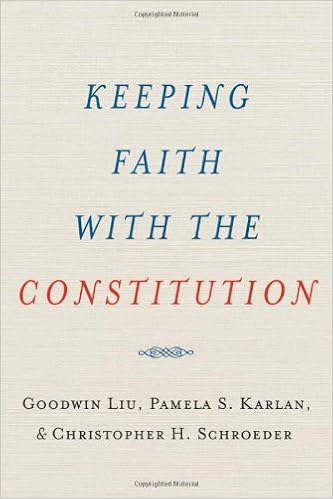
By Goodwin Liu, Pamela S. Karlan, Christopher H. Schroeder
Leader Justice John Marshall argued structure "requires that in basic terms its nice outlines may be marked [and] its vital items designated." Ours is "intended to undergo for a long time to come back, and therefore, to be tailored to many of the crises of human affairs." lately, Marshall's nice truths were challenged by means of proponents of originalism and strict development. Such felony thinkers as very best court docket Justice Antonin Scalia argue that the structure needs to be construed and utilized because it used to be while the Framers wrote it.
In Keeping religion with the Constitution, 3 criminal experts make the case for Marshall's imaginative and prescient. They describe their procedure as "constitutional fidelity"--not to how the Framers could have utilized the structure, yet to the textual content and ideas of the structure itself. the unique knowing of the textual content is one resource of interpretation, yet no longer the one one; to maintain the which means and authority of the rfile, to maintain it important, functions of the structure needs to be formed by means of precedent, old event, functional final result, and societal switch. The authors variety around the heritage of constitutional interpretation to teach how this process has been the resource of our best advances, from Brown v. Board of Education to the hot Deal, from the Miranda choice to the growth of women's rights. They delve into the complexities of balloting rights, the malapportionment of legislative districts, speech freedoms, civil liberties and the battle on Terror, and the evolution of exams and balances.
The Constitution's framers may perhaps by no means have imagined DNA, international warming, or perhaps women's equality. but those and plenty of extra realities form our lives and outlook. Our structure will stay important into our altering destiny, the authors write, if judges stay precise to this wealthy culture of edition and constancy.